Hidden compartment behind the Shinkansen bin
Bullet TrainThe Hidden compartment behind the Shinkansen bin turns an ordinary train fixture into a concealed storage space, first offering Nanao a way to hide a stolen suitcase and later giving its next searcher an unexpected discovery. Its importance rests on a small physical discrepancy: what appears to be a fixed wall beside the trash receptacle is, in fact, a panel with an empty upper shelf behind it.
Design and Access
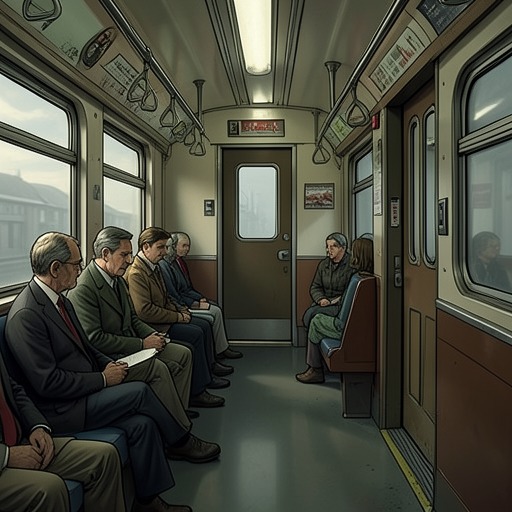
The compartment is concealed within the wall beside the train’s waste receptacle. From the passenger side, the receptacle appears to have separate openings for bottles and cans, a narrow slot for magazines and paper, and a larger flap for other rubbish. The fitting that releases the hidden panel is not an obvious keyhole. It is a small circular bump beside the paper slot, easily mistaken for part of the wall.
Pressing the bump causes a small metal handle to pop out with a click. Twisting it releases the panel, which swings open to reveal a locker-like space divided by a shelf into two levels. A heavy-duty plastic bag hangs in the lower section to collect deposited rubbish; the upper shelf is separate and, when Nanao finds it, empty. The arrangement suggests that the panel also provides cleaning staff with access to the collected trash. The hidden space is therefore built into the practical architecture of the bin rather than advertised as a separate compartment.
Nanao’s Use of the Compartment
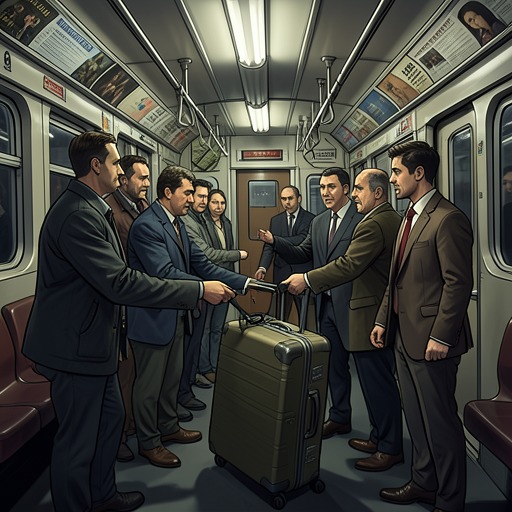
Nanao encounters the hidden space while holding Wolf’s body and gripping the suitcase handle. He is under pressure to deal with both quickly: the suitcase’s owner, in car three, may notice that it is missing and search the train, while carrying it openly risks exposing him. Looking for somewhere to put the body, Nanao notices the receptacle and examines its openings. The container first presents itself as a dead end; none of its visible slots could take the suitcase.
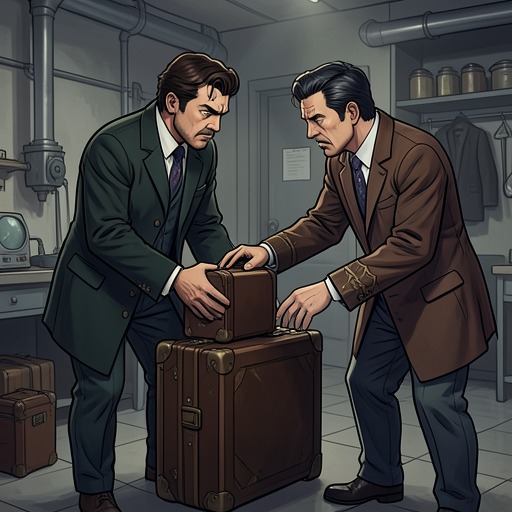
The almost imperceptible bump changes what the bin can do. Nanao presses it, twists the fitting, and discovers the panel and its empty upper shelf. Without pausing, he swings the suitcase onto the shelf one-handed, using his hold on the body, muscle, and momentum, then closes the panel. The case is hidden behind what passengers see as a waste receptacle, while the plastic rubbish bag remains below it. The concealment depends less on the size of the space than on its disguise and the inconspicuousness of its release mechanism.
The compartment does not solve Nanao’s other immediate problem. He still has Wolf’s body in his arms, and the ticket a child has picked up for him directs him to car six, row one. That nearby seat offers a separate place to put the body without raising suspicion. Keeping the two problems distinct matters: Nanao places the suitcase in the concealed compartment, then turns back to the corpse and the prospect of moving it. Finding the hidden shelf eases his anxiety only slightly, and his brief sense that events are finally going his way is checked by the thought that perhaps they are not.
Discovery and Reversal
The compartment is later found from the opposite direction. The searcher has already checked beneath the seats, the luggage racks, and the bathrooms, and knows the suitcase is too large to fit beneath a seat. With no particular reason to approach the bins except that the other locations have yielded nothing, he inspects the visible openings and peers inside, seeing only discarded containers. The compartment’s concealment works even for someone actively looking for the case: the obvious openings appear incapable of holding it.
Only then does he notice the little protrusion beside the paper slot. Pressing it releases the handle; twisting it opens the panel. Inside, he finds the rubbish bag on the lower level and the suitcase on the upper shelf, identifying it as the one he had seen when he met the man with the black glasses. He closes the panel and resets the handle rather than acting hastily. Nanao’s improvised hiding place has preserved the case from ordinary view, but it has not made the case inaccessible to someone who happens to recognize the fitting.
Narrative Function
The compartment’s two appearances give the same mechanism contrasting consequences. For Nanao, it is an accidental refuge discovered amid immediate confusion, and the empty shelf seems to make his predicament briefly manageable. For the later searcher, it is the answer to a search that has exhausted the train’s obvious storage places. The small fitting links concealment to discovery: the same unobtrusive feature that keeps the suitcase out of sight also supplies the clue that opens the space.
The bin’s change from familiar receptacle to hidden locker also makes the train’s ordinary interior newly uncertain. Its visible functions—sorting bottles, paper, and other rubbish—do not disclose everything the wall contains. In the sequence, material design actively redirects the action: Nanao’s need for concealment leads him to press the fitting, and the later searcher’s failure to find the suitcase elsewhere brings him to the same point. The compartment offers neither permanent security nor a simple solution; it changes who can see the suitcase, and when.